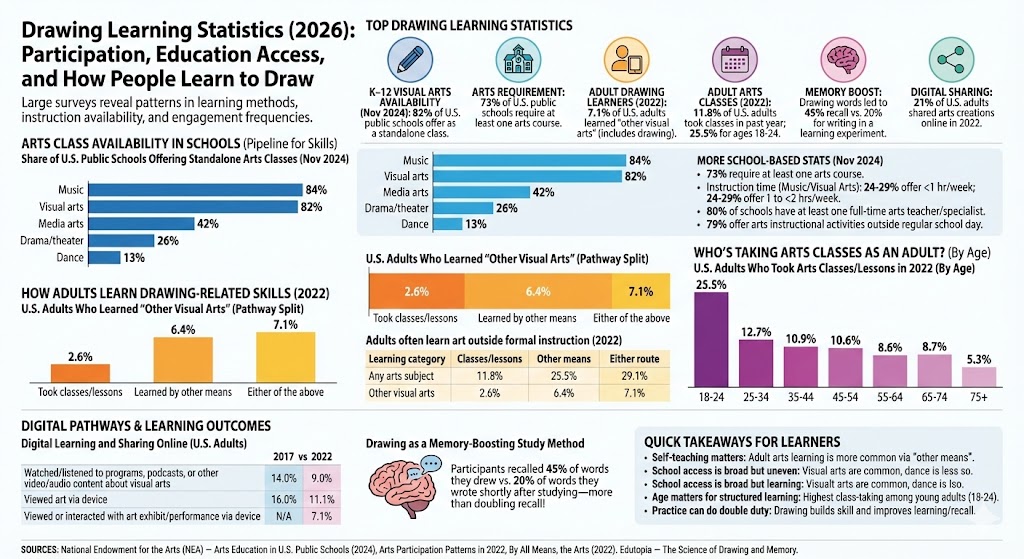
Learning to draw is often discussed as a personal journey, but large surveys also show clear patterns in how people learn, where instruction is available, and how frequently people engage in visual-arts learning and creation.
93% of U.S. public K–12 schools reported offering at least one standalone arts class during the regular school day (Nov 2024).
In that same school survey, 82% of public schools reported offering visual arts as a standalone class (Nov 2024).
73% of U.S. public schools reported requiring students to take at least one arts course (Nov 2024).
In 2022, 7.1% of U.S. adults learned “other visual arts” (e.g., drawing/painting/sculpture) through classes/lessons or other means.
In 2022, 11.8% of U.S. adults took arts classes/lessons (any arts subject) in the past year.
In 2022, 25.5% of adults ages 18–24 took arts classes/lessons (any arts subject) in the past year.
In 2022, 21% of U.S. adults shared their arts creations or performances on the internet.
One learning experiment found people recalled 45% of words they drew versus 20% of words they wrote shortly after studying.
Arts Class Availability in Schools (a key pipeline for drawing skills)
School access matters because drawing skills often begin in structured settings. A large national survey of U.S. public schools (Nov 2024) reported how common each discipline is as a standalone class during the regular school day.
Bar Chart: Share of U.S. public schools offering standalone arts classes (Nov 2024)
Discipline
Bar
Share of schools
Music
84%
Visual arts
82%
Media arts
42%
Drama/theater
26%
Dance
13%
Max = 84%. Widths: Music 100.00%, Visual arts 97.62%, Media arts 50.00%, Drama/theater 30.95%, Dance 15.48%.
More school-based stats linked to arts learning time and staffing (Nov 2024)
73% of public schools required students to take at least one arts course (any discipline).
Among schools with music and/or visual arts instruction, 26% (music) and 29% (visual arts) offered under 1 hour/week of instruction; another 29% (music) and 24% (visual arts) offered 1 to <2 hours/week.
80% of schools reported having at least one full-time arts teacher or specialist (any discipline).
79% of public schools reported offering arts-related instructional activities outside the regular school day.
How Adults Learn Drawing-Related Skills
For adults, learning to draw often happens through a mix of classes, informal mentoring, and self-teaching. In the national arts participation survey (2022), “other visual arts” is reported as a learning category and is commonly treated as a bucket that can include drawing-focused learning.
Bar Chart: U.S. adults who learned “other visual arts” in 2022 (pathway split)
Pathway
Bar
Share of adults
Took classes/lessons
2.6%
Learned by other means
6.4%
Either of the above
7.1%
Max = 7.1%. Widths: Took classes/lessons 36.62%, Learned by other means 90.14%, Either of the above 100.00%.
Adults often learn art outside formal instruction (2022)
Learning category (U.S. adults, 2022)
Classes/lessons
Other means
Either route
Any arts subject
11.8%
25.5%
29.1%
Other visual arts
2.6%
6.4%
7.1%
Who’s Taking Arts Classes as an Adult?
Drawing learners are part of a wider adult learning trend: in 2022, the share of U.S. adults who took arts classes/lessons (any arts subject) was 11.8%, up from 9.5% in 2017.
Bar Chart: U.S. adults who took arts classes/lessons in 2022 (by age)
Digital Pathways: Learning and Sharing Drawing Online
Digital consumption and sharing are important because they often substitute for in-person classes. In 2022, the national arts participation survey reported the following:
Digital engagement measure (U.S. adults)
2017
2022
Watched/listened to programs, podcasts, or other video/audio content about the visual arts
14.0%
9.0%
Viewed art via device
16.0%
11.1%
Viewed or interacted with an art exhibit/performance via device in a museum/theater/concert hall
N/A
7.1%
Learning Outcomes: Drawing as a Memory-Boosting Study Method
Drawing isn’t just something people learn—it can also be used to learn other content. In one study described for educators, participants recalled 45% of words they drew versus 20% of words they wrote shortly after studying—more than doubling recall for the drawn items.
Quick Takeaways for Learners
Expect self-teaching to matter: adult arts learning is more common through “other means” than through formal classes in national survey data.
School access is broad but uneven by discipline: visual arts classes are common in schools, while some disciplines (like dance) are much less available.
Age matters for structured learning: the highest class-taking rates are concentrated among younger adults (18–24).
Practice can do double duty: drawing can be both a skill to build and a tool to improve learning/recall.
Sources
National Endowment for the Arts (NEA) — Arts Education in U.S. Public Schools: Insights from the November 2024 School Pulse Panel Survey (PDF): https://www.arts.gov/sites/default/files/SchoolPulseSurvey_final.pdf
National Endowment for the Arts (NEA) — Arts Participation Patterns in 2022: Highlights from the 2022 SPPA (PDF): https://www.arts.gov/sites/default/files/2022-SPPA-final.pdf
National Endowment for the Arts (NEA) — By All Means, the Arts: A Full Report of the 2022 SPPA (PDF): https://www.arts.gov/sites/default/files/SPPA_Comprehensive_Report_FINAL.pdf
Edutopia — The Science of Drawing and Memory (article): https://www.edutopia.org/article/science-drawing-and-memory/